 Maplore Tiddi
 Desert locusts
Schistocerca gregaria. The insect this observatory watches.
TLDR
- 80 million
- 1 km² of swarm can hold up to 80 million adults and eat as much as 35,000 people in a day. FAO Locust Watch / FAO interactive
- 1 species
- They are grasshoppers that change behaviour, colour, and shape with density. That is phase polyphenism. Not a different species.
- 5–130 km
- Solitarious adults usually fly at night. Swarms fly by day, with the wind, often 5–130 km in a day; FAO also cites up to ~150 km when vegetation dries. They have crossed the Red Sea (~300 km) and, in 1988, West Africa to the Caribbean (~5,000 km in ~10 days). FAO FAQs
- 16 million km²
- Recession range: arid belt from West Africa through Arabia to India, ~16 million km² / ~30 countries. Upsurges can threaten ~29 million km² / ~60 countries. FAO Locust Watch / Cressman
- 0 swarm
- India, September 2026: recession. FAO Bulletin 574 (July 2026): Eastern Region calm. This site’s Hub extract: 13,177 India surveys, 0 swarm, 0 band, last obs 25 Aug 2026, all nil since 1 Jul 2026. Open the map.
ELI5
They are grasshoppers that, when crowded, stop avoiding each other, change colour, and start marching and flying together. Rain in the desert grows a little food. Locusts breed in that flush. Females lay eggs in moist sand. The eggs hatch into hoppers, which are wingless young. As the green dries, hoppers concentrate in the remaining patches. If they bump into each other enough, crowding flips their behaviour. They no longer hide. The crowd becomes a marching band, then a flying swarm. After five moults they grow wings. Satellites cannot see the insect itself. People in jeeps can. Control teams try to find the bands before they fledge. This observatory is built on those field surveys, not on a satellite picture of locusts.
This insect
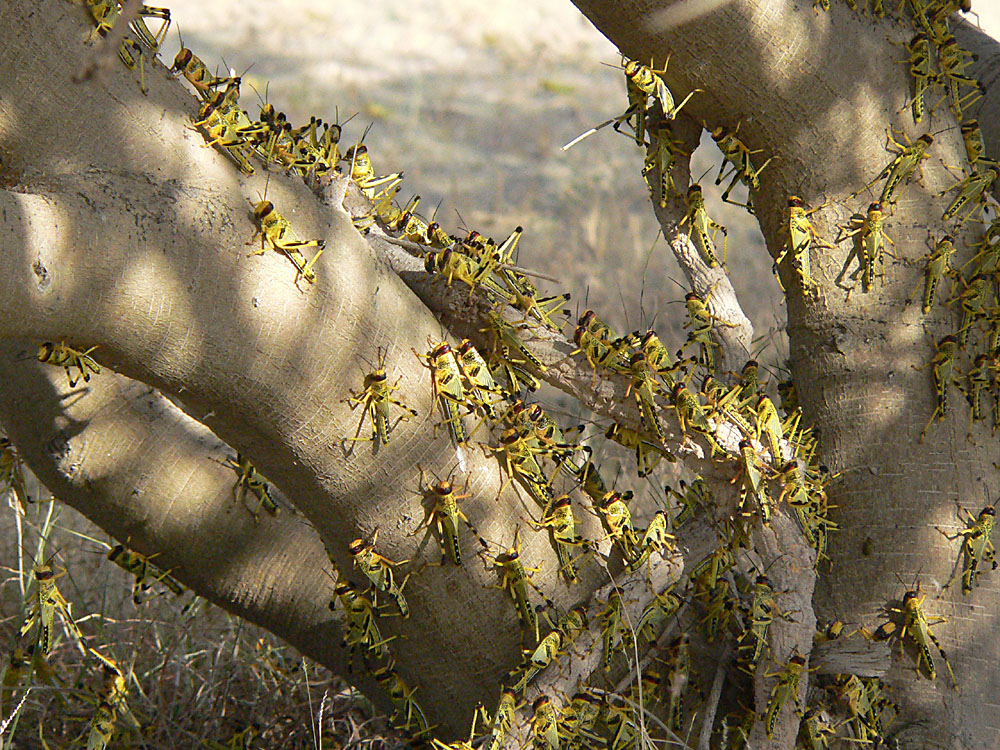
Latin name Schistocerca gregaria (Forskål). Family Acrididae. It is not Locusta migratoria (migratory locust) and not Australia’s Chortoicetes terminifera. The photos on this page are desert locust.
Locusts are grasshoppers. Grasshoppers, locusts, and crickets sit in one order: Orthoptera (straight-winged). A locust is not a separate animal. It is a grasshopper that can switch phase and swarm. Crickets are cousins: they chirp by rubbing the forewings; their ears sit on the front tibia. Grasshoppers and locusts scrape a hind femur on the forewing; their ears sit on the abdomen.
Life: eggs in moist sand → hoppers (wingless, five instars, L1–L5) → adults. About three months if FAO’s primer is used; that is the popular account, not a clock that always holds. A locust can eat roughly its own weight a day (FAO interactive).
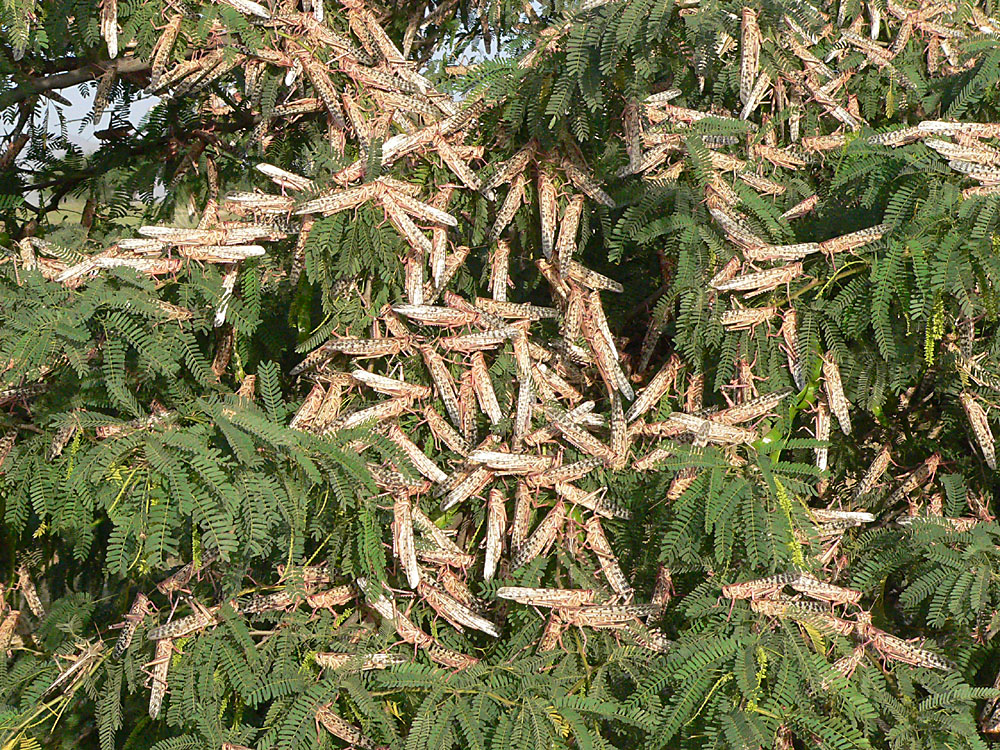
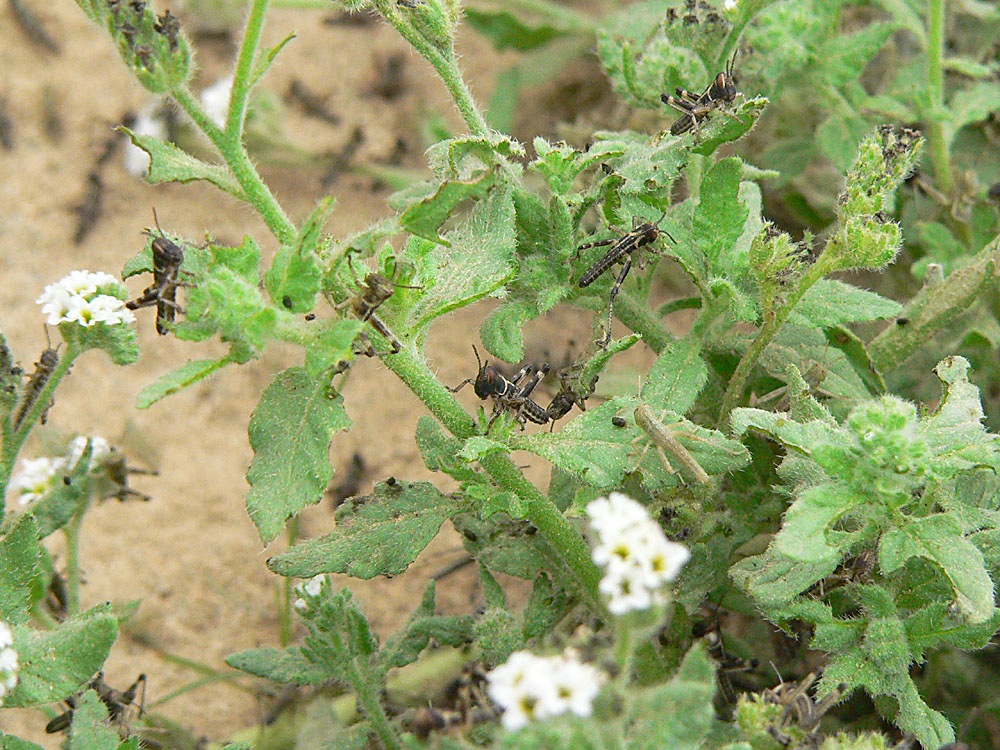

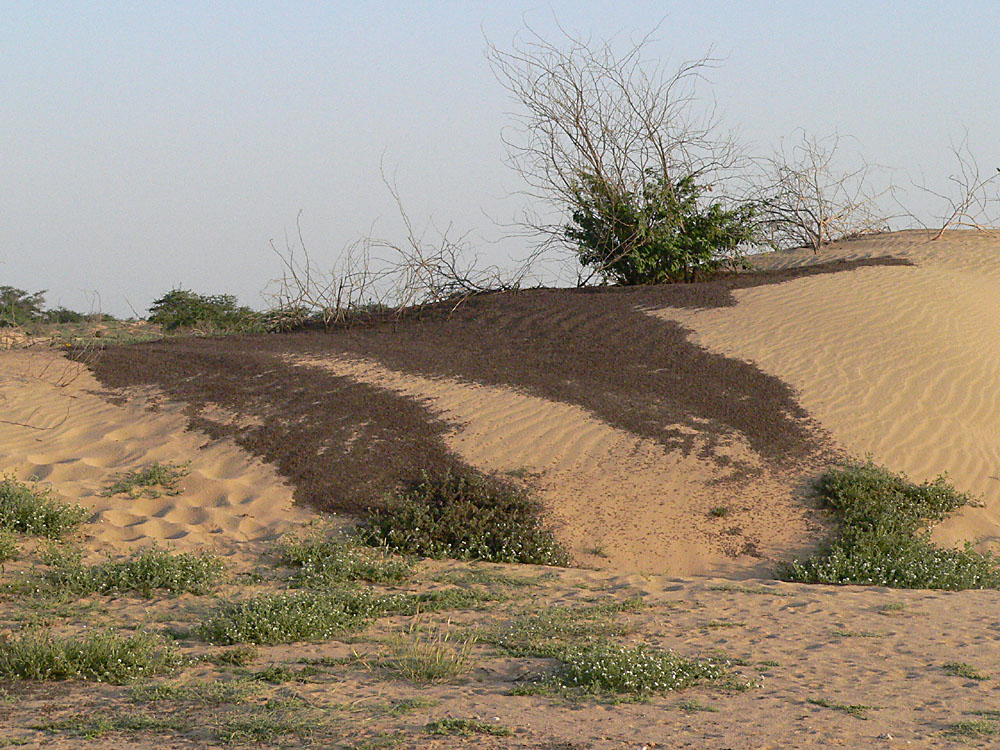

Two phases, one genome
Solitarious: camouflage, avoid each other, night flight. Gregarious: yellow and black hoppers, pink then yellow adults, bands then swarms, day flight.
The trigger is crowding. Mechanosensory hairs on the outer hind femur pick up the jostle (Simpson, Despland, Hägele, Dodgson, PNAS 2001, doi:10.1073/pnas.071527998). Serotonin in the thoracic ganglia is necessary and sufficient for the behavioural switch (Anstey, Rogers, Ott, Burrows, Simpson, Science 2009, doi:10.1126/science.1165939). Sight and smell are a second pathway. Colour and shape change over a longer period, and across generations. Serotonin is not a molecule that summons a cloud of locusts.
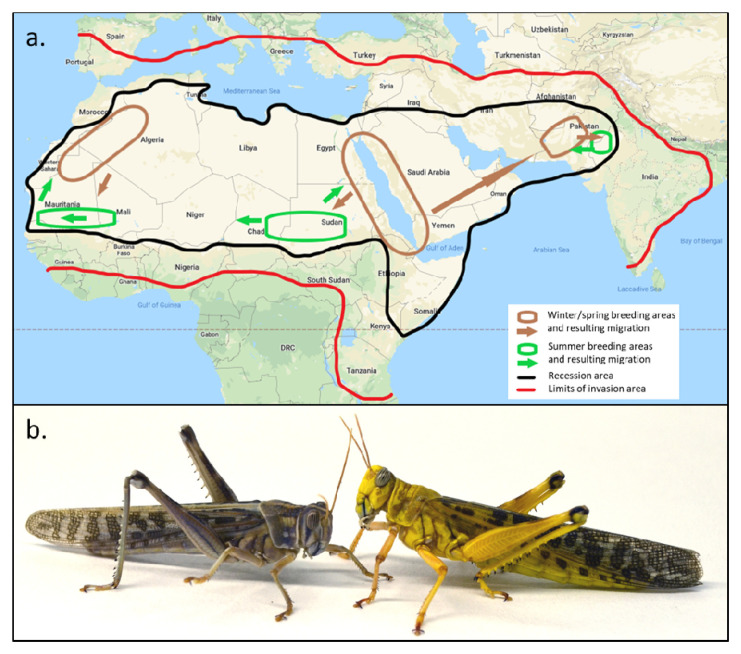
How a swarm actually starts
Rain → wet sand and green vegetation → breeding → hoppers concentrate in remaining green patches → jostling → gregarization → hopper bands → fledging → swarms migrate downwind to greener ground. FAO: when vegetation dries, swarms move on. Preventive control tries to find bands before they fledge.
India
Scheduled Desert Area: Rajasthan and Gujarat. Locust Warning Organisation, Jodhpur, under the Directorate of Plant Protection, Quarantine and Storage. Field chain: eLocust3 → RAMSES (Jodhpur) → FAO DLIS Rome → Locust Hub.
SWAC is FAO’s oldest regional locust commission: Afghanistan, India, Iran, Pakistan.
The 2019–2022 upsurge reached India, notably in 2020. This map’s 2020 archive is that season, labelled historical. Current state: recession. Surveys continue because that is when the next one is missed. District list · Map.
Crops and food
A locust eats about its own weight a day (FAO interactive). One square kilometre of swarm holds up to 80 million adults — the food of about 35,000 people in a day (FAO Locust Watch).
They eat cereals, pasture, and almost any green crop in the path: maize, sorghum, barley, rice, sugarcane, vegetables, fruit trees, weeds (FAO FAQs). That is why Scheduled Desert Area farmers, and PPQS / Locust Warning Organisation, exist.
India incursions, scheduled and non-scheduled desert areas: 1993, 1997, 2005, 2007, 2010, 2019, 2020, 2021, 2023 (FAO India, Dec 2024). 2020 is the season this map archives.
Food security
FAO’s mandate is early warning, so countries are not surprised. DLIS watches, forecasts, and alerts frontline states (FAO Locust Watch).
Preventive control of hopper bands is cheaper than spraying swarms: hoppers are still on the ground, less mobile, more sensitive to pesticide (FAO, why a preventive approach).
Climate
Breeding needs rain in arid land: moist sand for eggs, green vegetation for hoppers. Unusual rain can grow that vegetation in the recession area and help an upsurge. That is not the same as saying climate change causes swarms.
The usual cited prelude to the 2019–22 upsurge is rain in the Empty Quarter: cyclones Mekunu (May 2018) and Luban (October 2018) allowed two generations of breeding near the Yemen–Oman border (FAO, 15 Feb 2019; Keith Cressman, then Senior Locust Forecasting Officer).
Satellites see habitat — rain, greenness, soil moisture — not the insect. Same honesty as the breeding layer on this map. IRI locust maproom.
Who watches
| Who | Where | What they actually do |
|---|---|---|
| FAO Desert Locust Information Service (DLIS) | Rome | Daily watch, monthly bulletin, Locust Hub. Forecasting officers: Jerry Roffey (1979–1989), Keith Cressman (1987–2024), Cyril Piou (from 2024; CIRAD, seconded). Senior Agricultural Officer listed on Locust Watch: Shoki Al-Dobai. eclo@fao.org |
| Locust Warning Organisation (LWO) | Jodhpur | India’s surveys and control in the Scheduled Desert Area. Directorate of Plant Protection, Quarantine and Storage — ppqs.gov.in |
| SWAC / CRC / CLCPRO | FAO regional commissions | SWAC (4): Afghanistan, India, Iran, Pakistan. CRC (17): Central Region, around the Red Sea and Near East. CLCPRO (11): West and North-West Africa. |
| DLCO-EA | Eastern Africa | Desert Locust Control Organization for Eastern Africa. Collaborates with CRC. |
| CIRAD | France | Acridology. Piou’s lab: phase polyphenism, risk models. agents.cirad.fr/cyril.piou |
| University of Oxford / Cambridge groups | UK | Stephen J. Simpson, Stephen M. Rogers, Swidbert R. Ott, Malcolm Burrows — the hind-leg and serotonin work. |
| IRI (Columbia) | New York | Rainfall and greenness maproom used by locust people: iridl.ldeo.columbia.edu/maproom/Food_Security/Locusts/ |
| JRC / VITO | EU / Belgium | Dynamic greenness maps for DLIS. Habitat, not locusts. |
| Lobelia Earth | Barcelona | 1 km soil moisture viewer on Locust Hub. |
Papers
- Gregarious behavior in desert locusts is evoked by touching their hind legs · Simpson SJ, Despland E, Hägele BF, Dodgson T · 2001 · PNAS 98(7):3895–3897 · doi:10.1073/pnas.071527998
- Serotonin mediates behavioral gregarization underlying swarm formation in desert locusts · Anstey ML, Rogers SM, Ott SR, Burrows M, Simpson SJ · 2009 · Science 323(5914):627–630 · doi:10.1126/science.1165939
- A forecasting model for desert locust presence during recession period, using real-time satellite imagery · Marescot L, Fernandez E, Dridi H, Benahi AS, Hamouny ML, Maeno KO, Escorihuela MJ, Paolini G, Piou C · 2025 · Remote Sensing Applications: Society and Environment 37:101497 · doi:10.1016/j.rsase.2025.101497
- Development and application of multi-temporal colorimetric transformation to monitor vegetation in the desert locust habitat · Pekel JF, Ceccato P, Vancutsem C, Cressman K, Vanbogaert E, Defourny P · 2011 · IEEE J. Sel. Top. Appl. Earth Obs. Remote Sens. 4(2):318–326 · doi:10.1109/JSTARS.2010.2052591
- Desert Locust Guidelines · FAO · 2001 (and later updates) · Food and Agriculture Organization of the United Nations, Rome
- Locust Handbook · Steedman A (ed.) · 1990 · 3rd edition, Natural Resources Institute, Chatham
Sources
- Peter Weatherall, Grasshoppers, Locusts and Crickets
- FAO Locust Watch
- FAO Desert Locust FAQs
- FAO interactive: desert locusts
- FAO Locust Hub
- FAO India: combatting desert locust (Dec 2024)
- FAO, 15 Feb 2019: Empty Quarter rains / Cressman
- FAO: why a preventive approach
- IRI locust maproom
- Named papers above (Simpson 2001; Anstey 2009; Marescot 2025; Pekel 2011; FAO Guidelines; Steedman 1990)
Not an official FAO or LWO page.